3D art pipeline

How a character goes from Mike's sketch to the game. The first one through is the man: a bare body that clothes go onto piece by piece, so a player can change what he wears. Some of this is built, some is in progress and some is not started; each step says which.

New to 3D? A character is three things: a shape made of triangles (the mesh), a picture wrapped round it (the texture), and bones inside it that bend it (the rig). The other words are explained as they come up.

11 steps, and a second routeas of 2026-11-12; the second route 2026-11-14the detail, with every command: docs/ART_PIPELINE.md, "A character, from a sketch to the game"
Mike's baseline sheet: the bare man from the front, side and back
Draw itMike · a sheet from every side
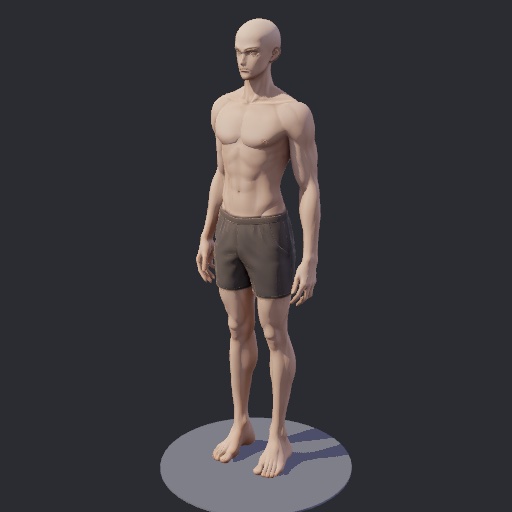
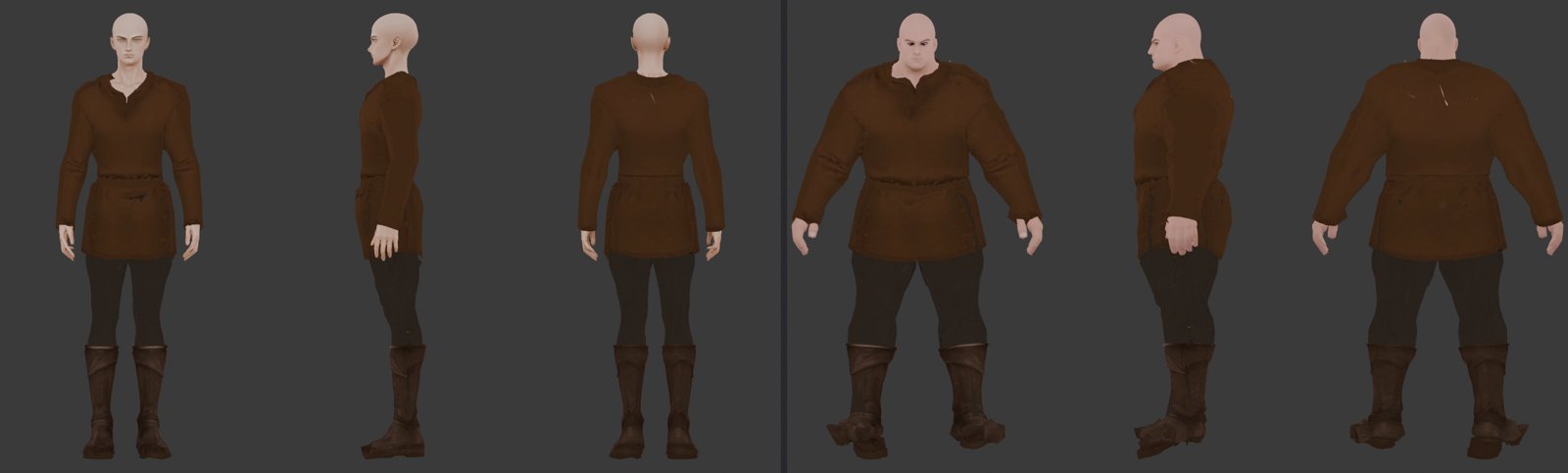
The bare base body as a 3D model
Model it, rig ita generated base, on our skeleton
A tunic, trousers and boots as separate meshes
Dress itclothes as separate pieces · the swordsman's outfit
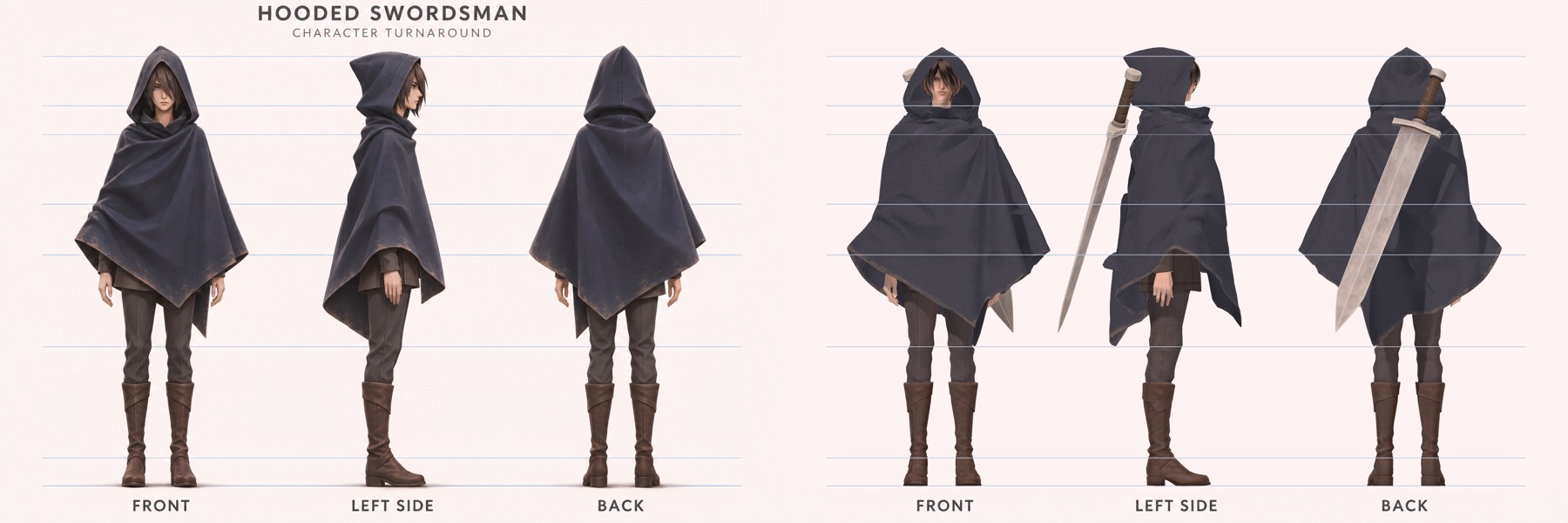
The Hooded Swordsman sheet beside the model in the game
Judge it, play itagainst the sheet, then in the game
01

The sheets

start here · Mike

Everything starts from a turnaround sheet: the same figure drawn from several sides, at one size, on one page. The model is made from it and judged against it, so what the sheet does not show cannot be made well.

  • Front, side and back, plus two three-quarter turns (38 to 45 degrees, one each way). The three-quarter views are required: that is the angle players see most, and a model can't be judged at an angle nobody drew.
  • Drawn flat: a level camera with no perspective, every view the same size, the same even light in each.
  • Arms held clear of the body (about 20 to 25 degrees), feet a little apart, fingers apart. An arm drawn against the side comes back fused to the body.
  • Left and right the same.
  • The base figure bare, bald, in fitted shorts. Then each layer of clothing drawn with the layer above it off: a piece can only be made where a drawing shows it.
  • Every build that will ship, at the same size: here skinny, medium and bulky.
  • A separate close-up of the head, at least 600 px tall: the face's paint comes from it.
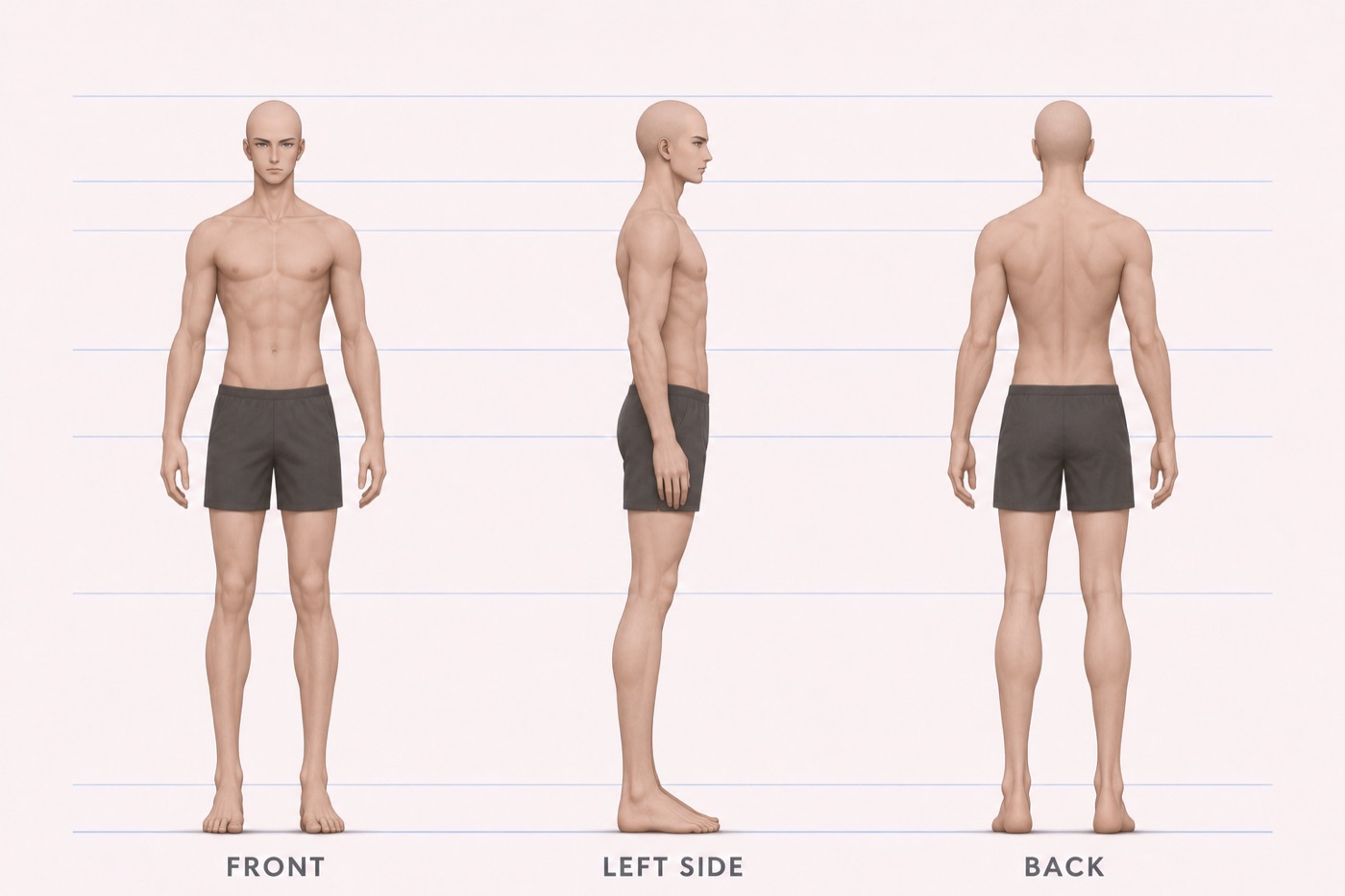
Mike's male human baseline turnaround: front, left side and back, bald, in shorts
The baseline: the bare man, medium buildMike's drawing · the bar for the body
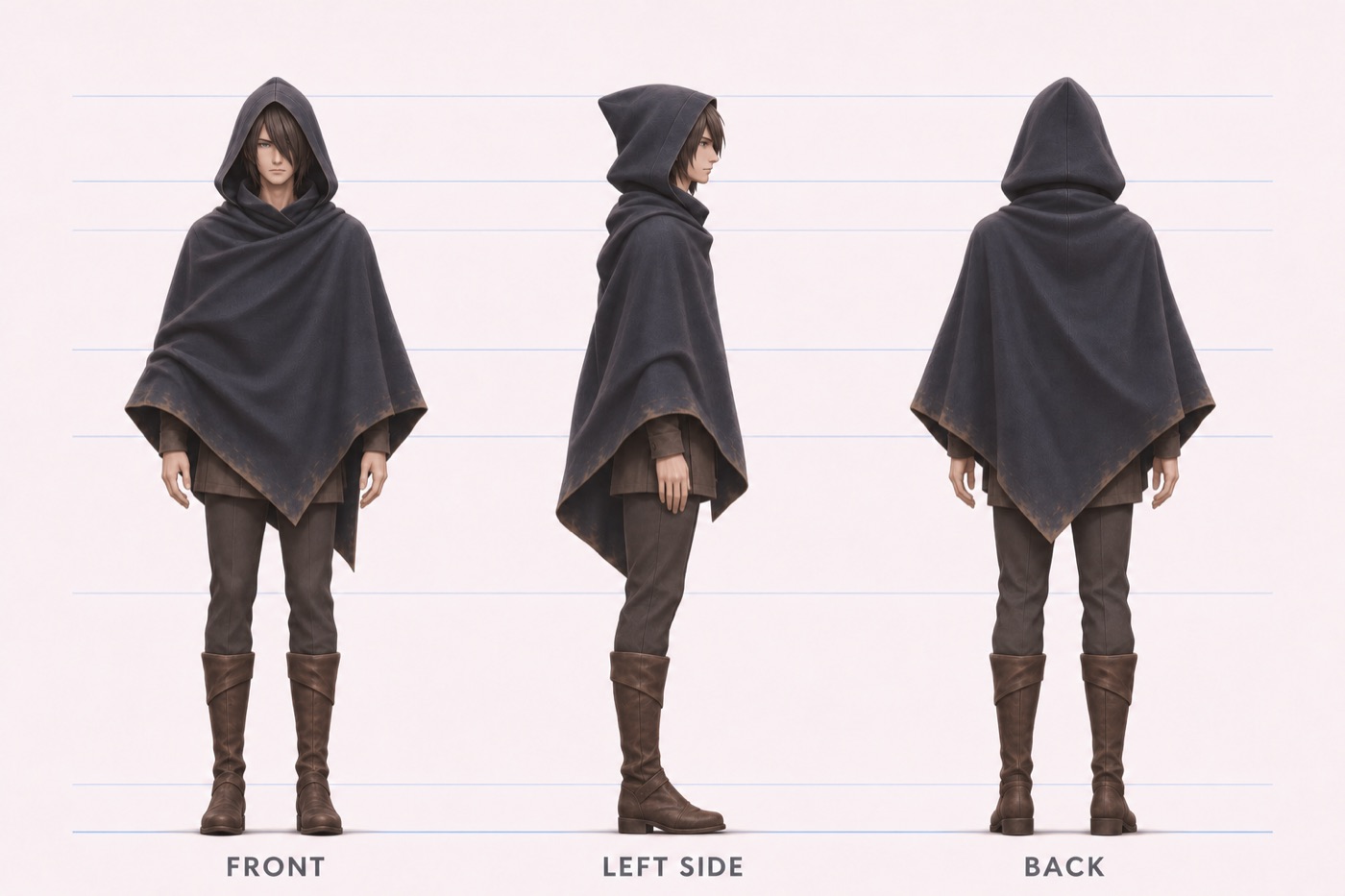
The Hooded Swordsman drawn on the baseline's stance, poncho on
The same man dressed, on the same stanceMike's drawing · the poncho still covers the tunic, so the outfit with the poncho off is still needed
02

Check the sheet against itself

before any modelling · not built yet

Each view is measured against the others: size, outline, where the eyes, nose, chin and ears sit, and how far the three-quarter views are really turned. A sheet that disagrees with itself goes back to be redrawn.

Why: on the baseline sheet the views disagreed in a handful of places (the back view's ears and nape wider than the front's, the side view's crown a little lower, the mouth a little low in profile, the skin tone different between front and side). A model cannot match two drawings that differ, so each place became a written exception: the model follows one view there and is not judged against the other. The check is there so the next sheet needs none. Today the measuring tools live inside the face work and nothing checks a sheet up front.

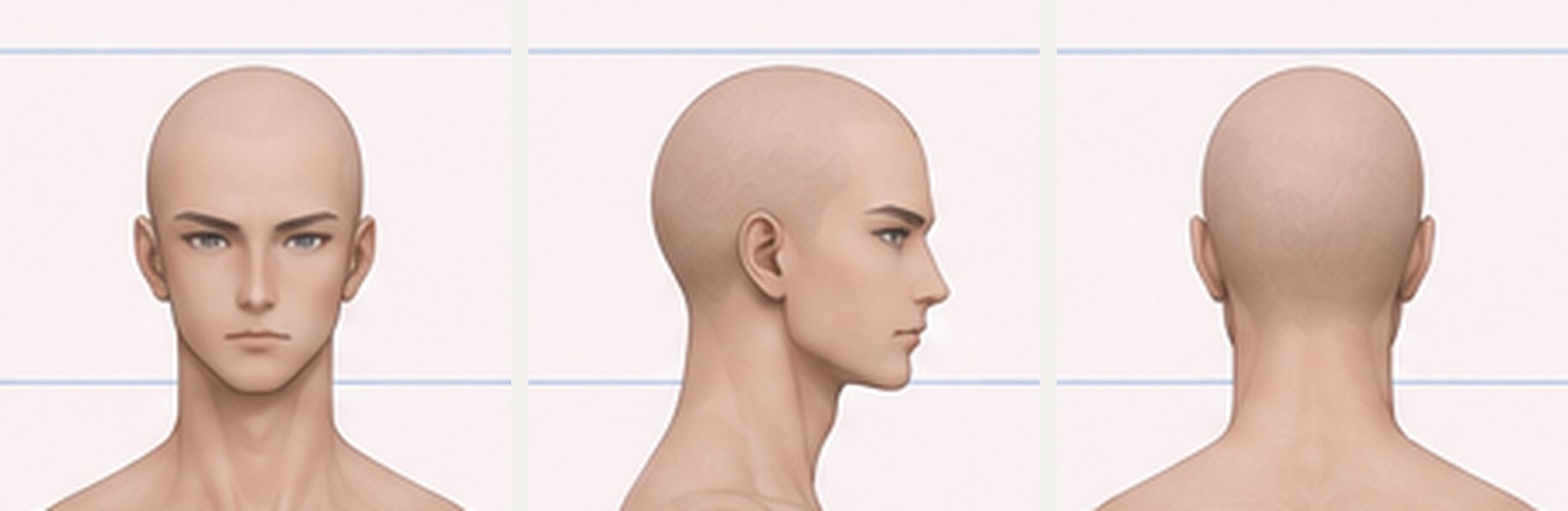
The baseline sheet's head, enlarged, from the front, side and back
One head, three drawingsMike's baseline sheet, enlarged · the check asks whether these three can all be the same head
03

A 3D base from the sheet

Mike · built for the man

A generator (Tripo) turns the bare sheet into a textured model with a rig. Mike's model of the baseline is the man's base.

  • Made on a paid plan, by the account that holds it, and written down beside the model the day it is made. That is what lets us ship it and open the repo.
  • Ask for the lowest-polygon export. This one came at 53,102 triangles; the whole man, clothes and all, has 40,000 to spend.
  • Its rig is not ours. The bones have our names, but the joints sat 1 to 7 cm from ours, and its weights (how much each bone pulls each part of the surface) opened the shorts in a crouch and the mouth on a head tilt. Step 6 fixes that.

We also tried generators that run on our own Mac on the same sheet. They gave a bulkier body with junk at the eyes, at about 850,000 triangles, so Mike's model is the base.

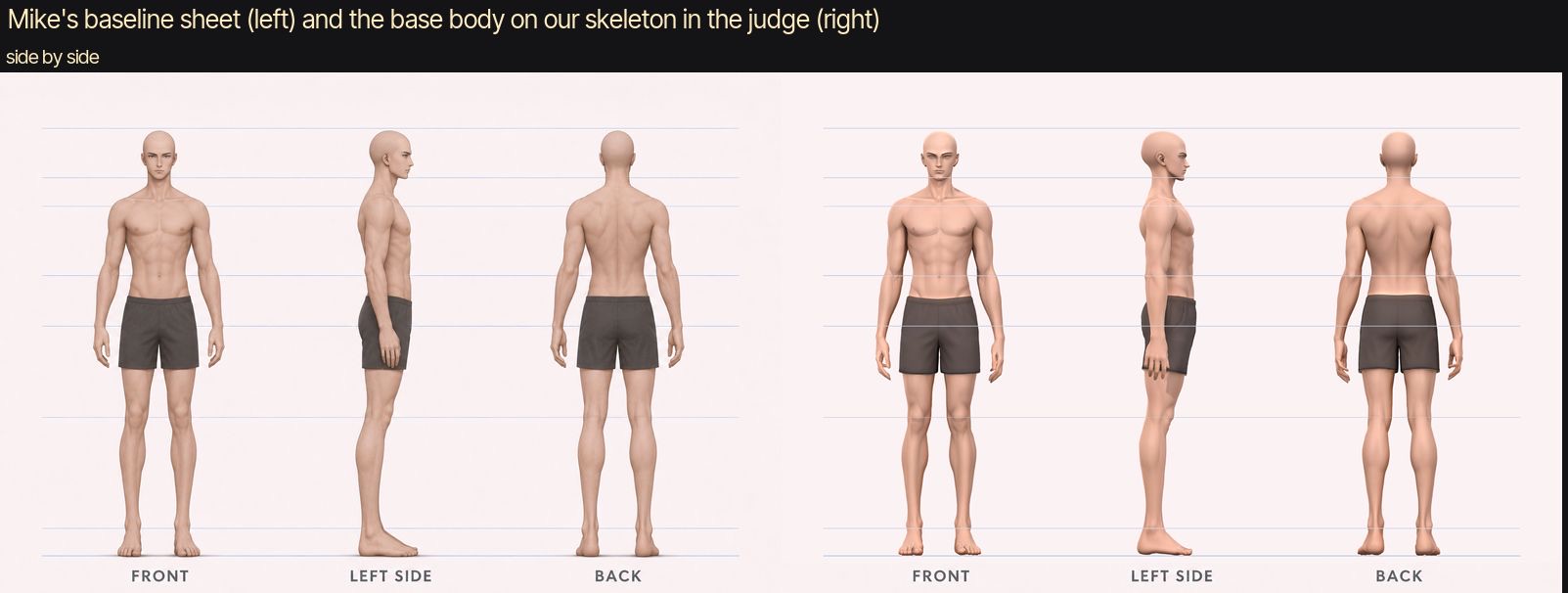
Mike's baseline sheet beside the base model, front, side and back
The sheet, and the model made from itleft: Mike's sheet · right: the generated model (shown on our skeleton, step 6, before the face work)
04

The head and face

Mike's director · in progress, #1535

The generated head is close but not Mike's. The bar here is whether it reads as his character, judged by a person; matching the drawings pixel by pixel cost more than a day on the first head.

  • Several heads are generated on their own from the close-up sheet (head, neck and shoulders), so each gets the generator's full detail. Agents throw out only the plainly broken ones and clear away stray pieces, and Mike picks one or two from a labelled sheet of all five views.
  • One half is built and mirrored first. Then only what a person names is fixed, three rounds at most a section: first a smooth reshaping, then the same part taken from another candidate (an ear), then a new generation. Rebuilding a patch of surface by hand, a local remesh, is the last resort.
  • A section the artist has accepted is frozen: a check fails any later change that moves it by more than a pixel. Holes, seams and dragged paint are hard checks too; outline and colour scores are only a guide.
  • The paint is a texture bake: the sheet's own colours written onto the model's texture, each view painting only what it sees squarely, one fading into the next where they meet.
  • At the end two or three finished heads are shown in the game's light with hair and hood on, and Mike and Peter choose.

Where it stands: the mouth has passed; eyes and eyebrows are close; nose and ears are being rebuilt. The work is on a branch and not in the game, so there is no picture of the new head here yet. The body and the rig below the neck are not touched by any of it.

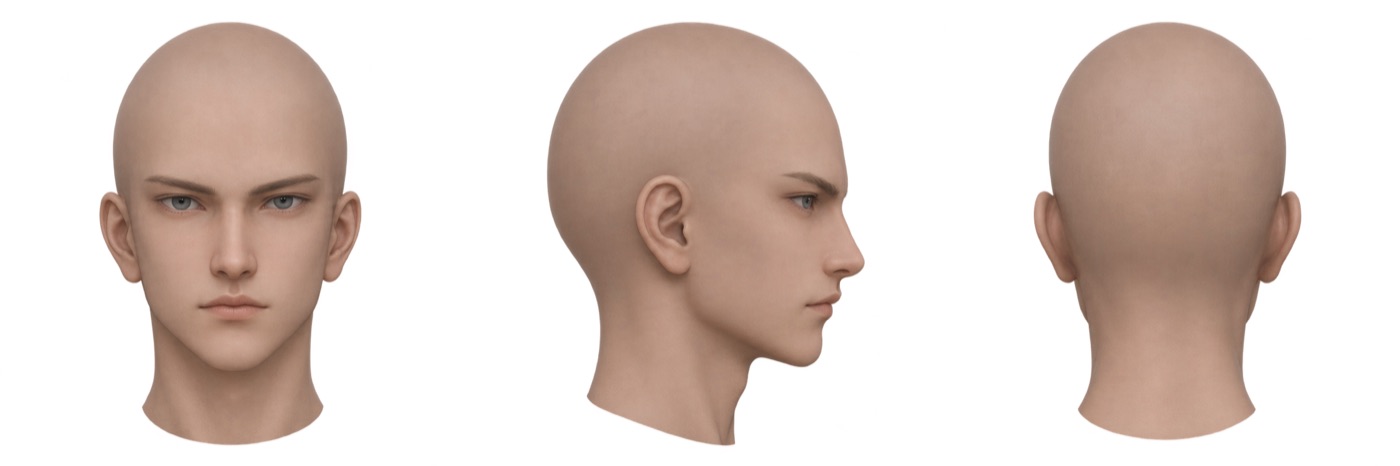
Mike's close-up bald head turnaround: front, side and back
A close-up head sheetMike's drawing · this one is the head today's man wears; the new head's own close-up and its renders are on the branch, not here yet
05

Simplify below the neck

Peter's director · not built, #1542

To simplify (or decimate) a mesh is to merge its triangles until fewer are left, keeping the shape as well as it can. The body comes down from 53,102 triangles to about 20,000, the head and hands kept the most detailed. The budget stays where it is.

It runs after the face work, which needs the model's original points, and before everything below: the rig, the region map and the clothes are all made on the simplified body. (Retopology, drawing a new clean mesh over an old shape, is the heavier version of this job; asking the generator for a light export is how we avoid needing it.)

The bare base body on a turntable
The body before it is simplified53,102 triangles today · about 20,000 after
06

Onto our skeleton

Peter's director · first pass built, #1557

Every traveler shares one skeleton of 65 bones, so one set of animations, one poncho and one set of weapon grips work on all of them. A recipe carries the body onto it: it keeps the generator's weights, drops its skeleton, turns the arms and legs onto our bones, and fixes the weights by rule (the shorts move with the skin under them, the head is rigid on its bone).

It is held by a check in every one of the 289 animation clips: nothing may stretch more than today's man does.

Still to do: the arms. Our shoulder joints sat 2.8 cm nearer the middle than this body's, so the first pass stretched the arms and the fingertips hang 5 to 6 cm lower than on the sheet. Peter's call: move the skeleton's arm joints to where this body has them, and recheck the poncho, the grips and today's man in the same change.

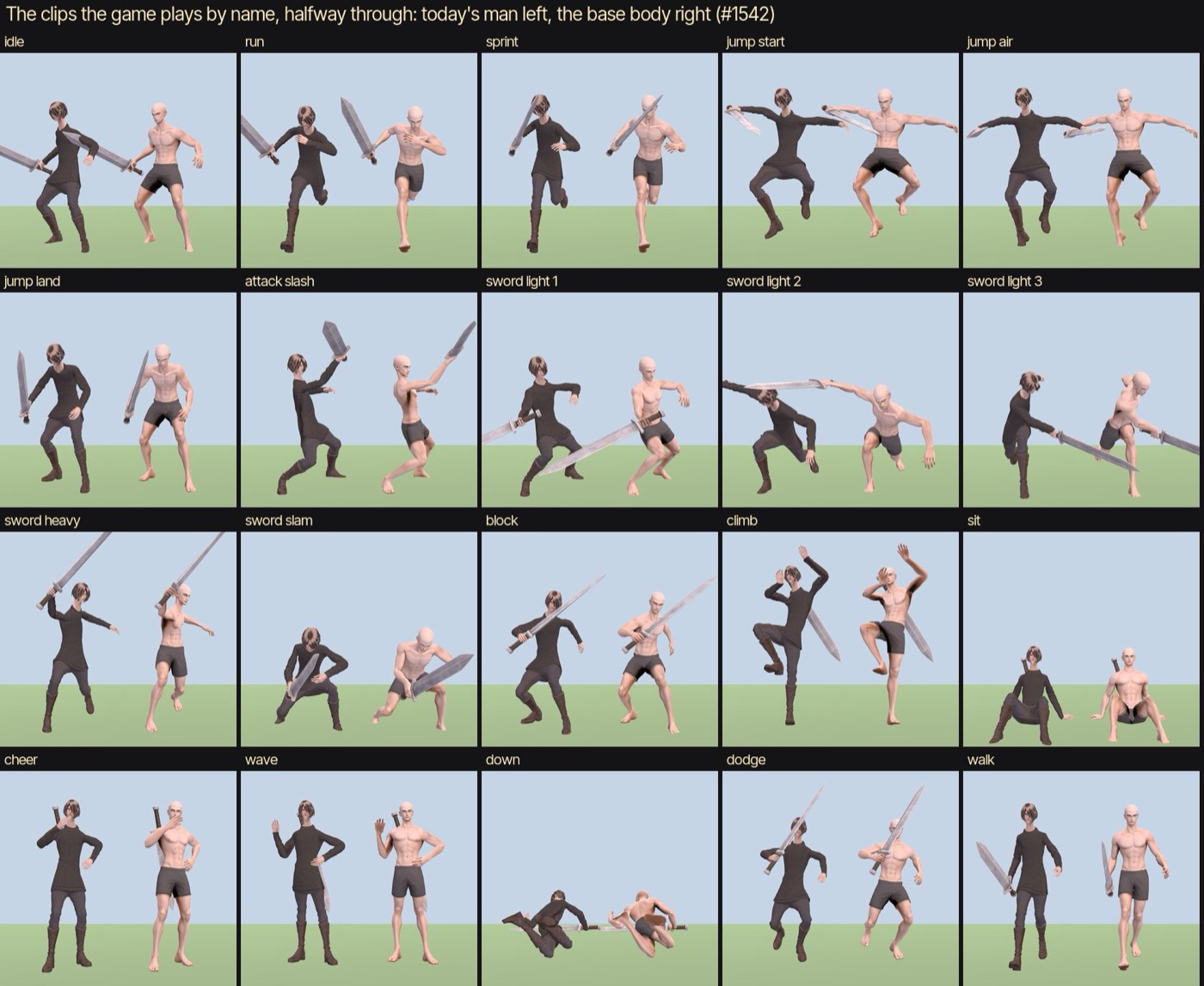
Twenty animation clips, each showing today's man and the bare base body in the same pose
The base body in the game's clipstoday's man left, the base body right · first pass: the arms are still stretched
07

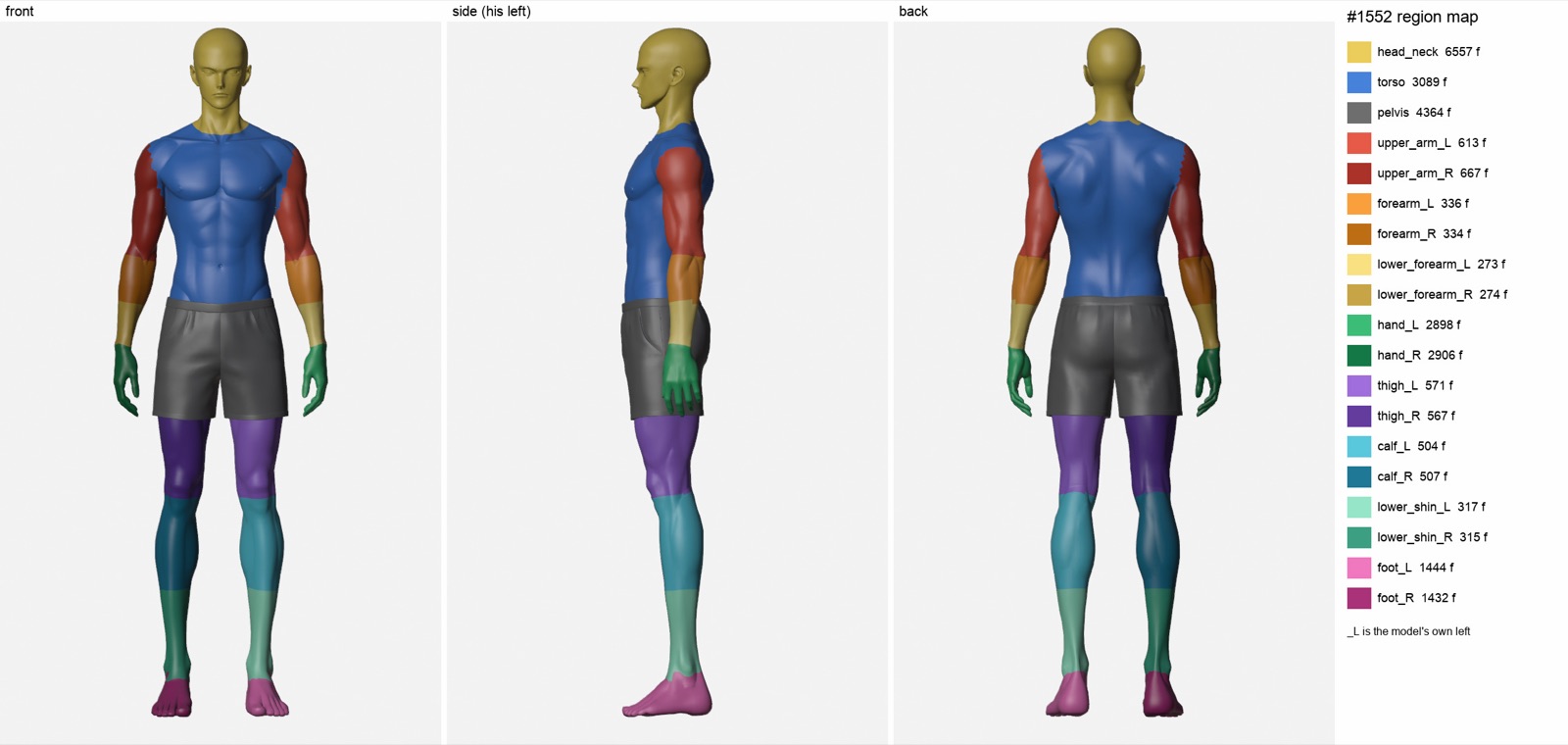
The region map

Mike's director · built, to be redone on the simplified body

When a piece of clothing goes on, the skin under it is hidden, so skin never pokes through cloth. The region map says which part of the body every face of the mesh belongs to, where the seams run, and how far a piece's edge has to reach past a seam (at least 2.5 cm) so the cut is always under cloth.

It reaches the game as a picture laid out like the body's texture (in its UVs: the map of which spot of a picture lands on which spot of the surface). It is made again once the body is simplified; the fit tool lays it into the body's UVs for the game (the base body's and, by rule, the bulky man's).

The base body from the front, side and back, each region in its own colour
Nineteen regionsa glove hides the hand and lower forearm, a boot the foot and lower shin · on the body as generated
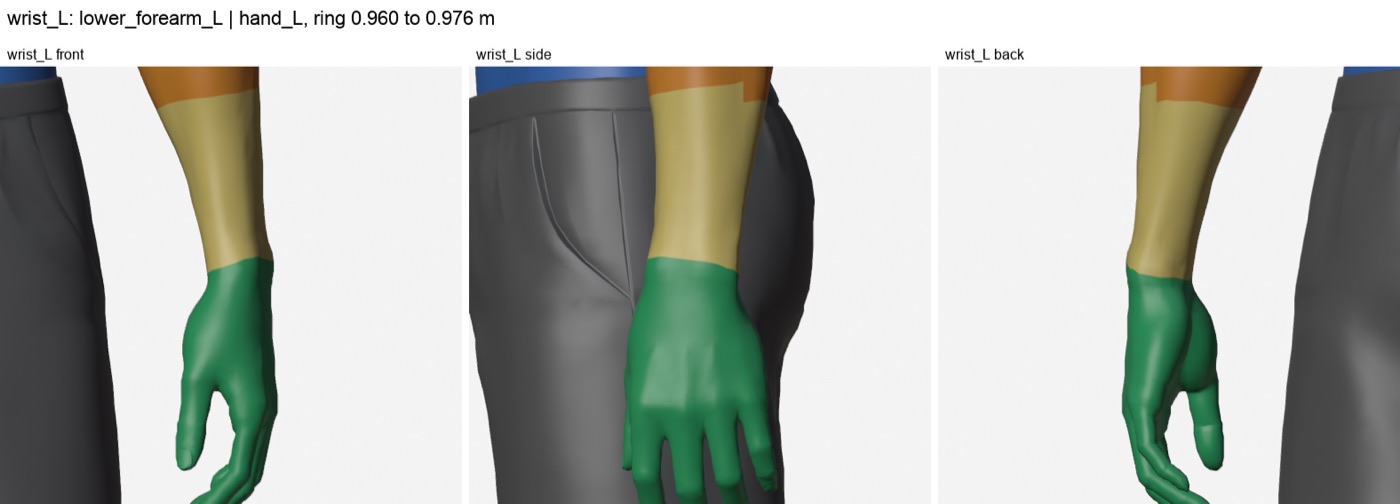
Close views of the wrist seam between the lower forearm and the hand
One seam, up closethe wrist: where a glove's or a sleeve's edge has to pass
08

Clothes as pieces

Peter's director · waiting on art, #1547

Each piece (tunic, trousers, boots) is its own mesh on the same skeleton. The fit tool takes a piece and any body on our skeleton and does the rest: carries the piece onto the body's joints, settles it a few millimetres off the skin, gives it the weights of the body under it so the two move together, and writes down which regions of the body it hides.

The swordsman's outfit is generated: a picture of the man wearing one piece at a time (made from his sheet with the poncho off), a 3D sample of each, and the cloth cut out of it. One piece fits the base body and the bulky man alike.

The tunic, trousers and boots on the base body and on the bulky man, front, side and back
One outfit, two bodiesthe base body and the bulky man · each piece fitted by the tool
09

The Build slider

Peter's director · not built

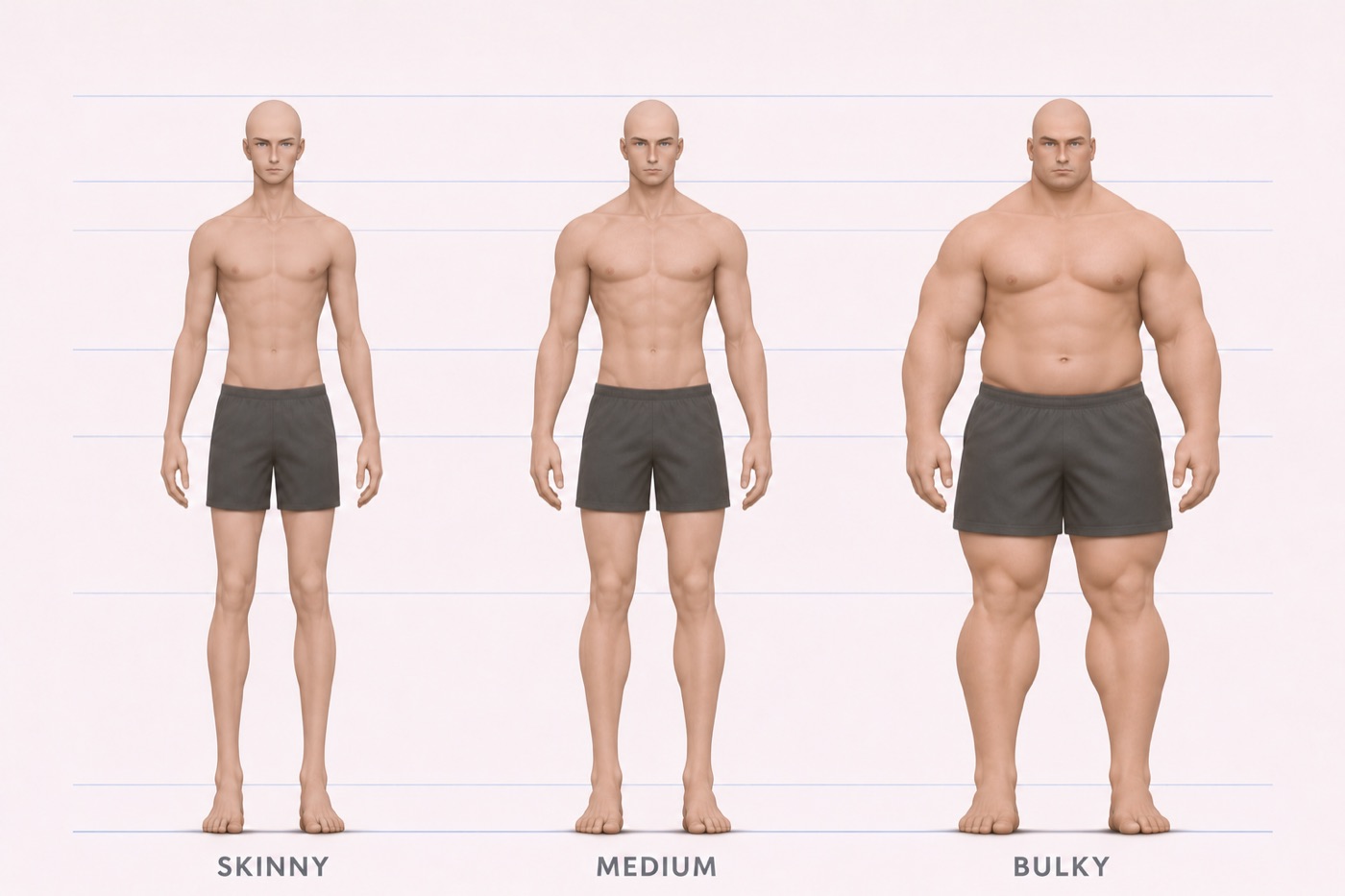
One slider: skinny at one end, medium in the middle, bulky at the other, from Mike's three drawings. A new character starts at medium. It changes how he looks and nothing else.

It works with blend shapes: a second position stored for every point of a mesh, which a slider blends towards. The body gets one for skinny and one for bulky, and each piece of clothing gets the same two, made by fitting it at each end. Today's man still has the two older sliders, Weight and Muscle, until this one is built.

Mike's drawing of the skinny, medium and bulky builds, bare, from the front
Skinny, medium, bulkyMike's drawing · the slider's two ends and its middle
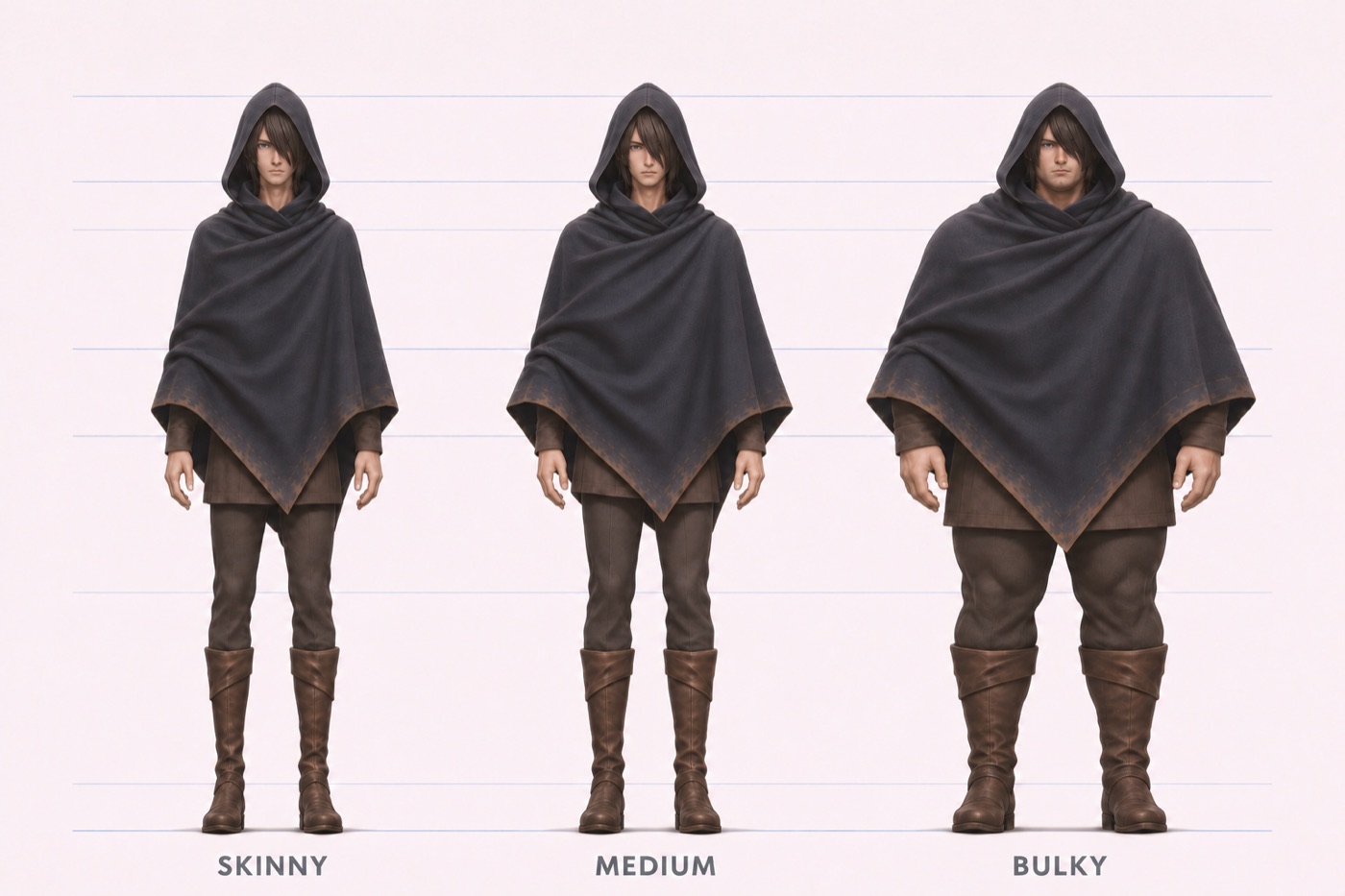
Mike's drawing of the three builds dressed as the Hooded Swordsman
The same three, dressedMike's drawing · how the outfit and poncho should sit on each
10

The poncho, hair and hood on top

Peter's director · not started for the new body, #1541

The poncho is already its own asset: cloth that is simulated as he moves, hanging from pins at the shoulders and kept out of the body by simple pill shapes on his bones. The hair and the hood sit on the head.

All of it is fitted to today's man. For the new one the pins and pill shapes move to the new shoulders and arms, and the hair and hood are refitted to the new head. The bare body is bald for now, so the poncho cannot go on it in the game yet. This is the last step.

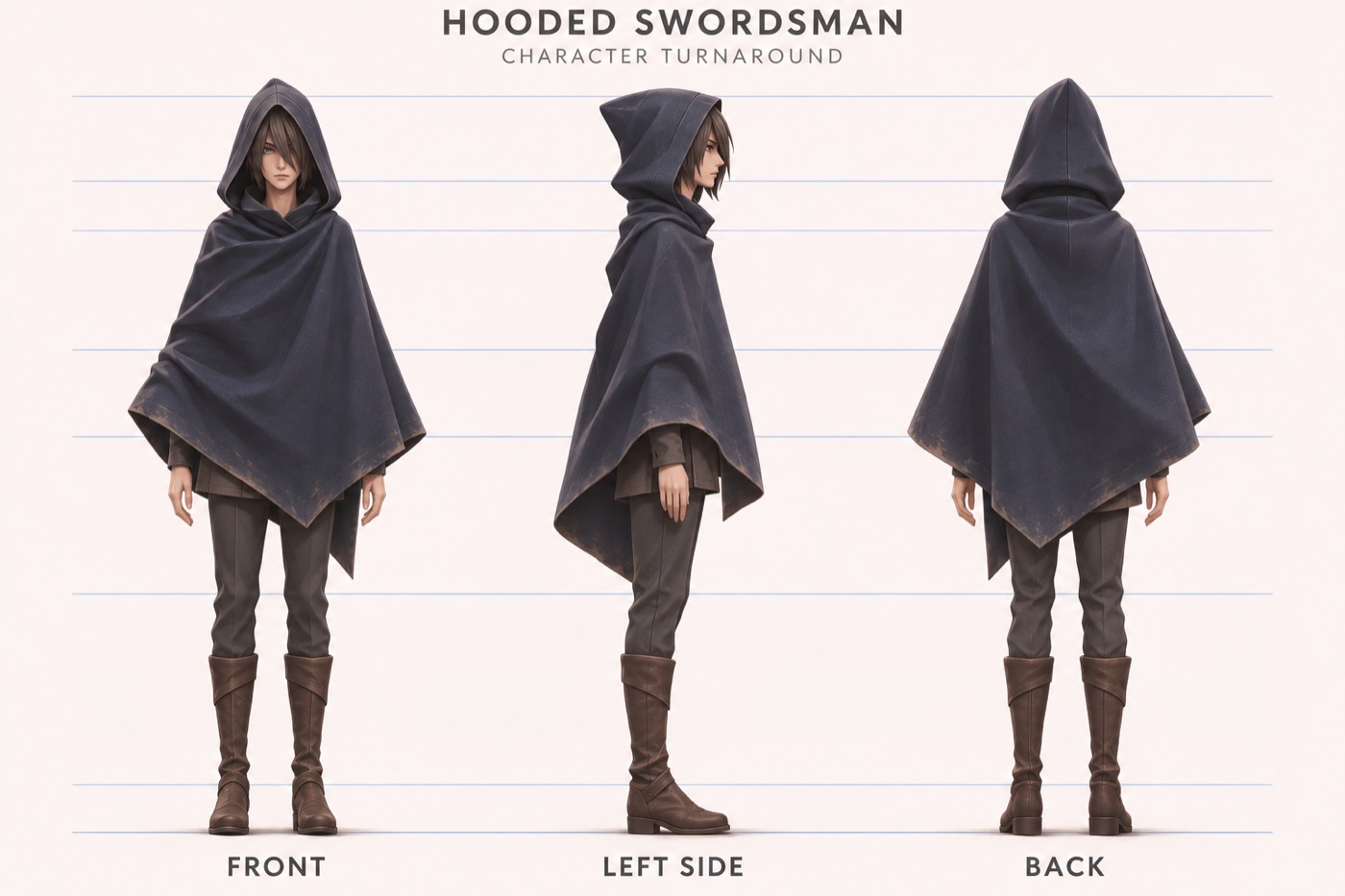
Mike's Hooded Swordsman turnaround: front, left side and back
The Hooded SwordsmanMike's drawing · the bar for the dressed man
11

Into the game

Peter's director · behind a switch

The game can already draw a man as a body plus the pieces he wears, behind a developer switch (--segments), wearing the swordsman's outfit. Three pieces cost about 0.3 thousandths of a second a frame with 32 travelers on screen.

It becomes the default when the real body and real pieces are in, the whole man fits the budget (40,000 triangles without the cloak, 50,000 with it), the checks pass in every clip, and Peter and Mike have seen him beside the sheet and beside today's man and said yes.

The judge draws any candidate on the sheet's own page at the sheet's size, front, side and back, so the two can be compared line for line.

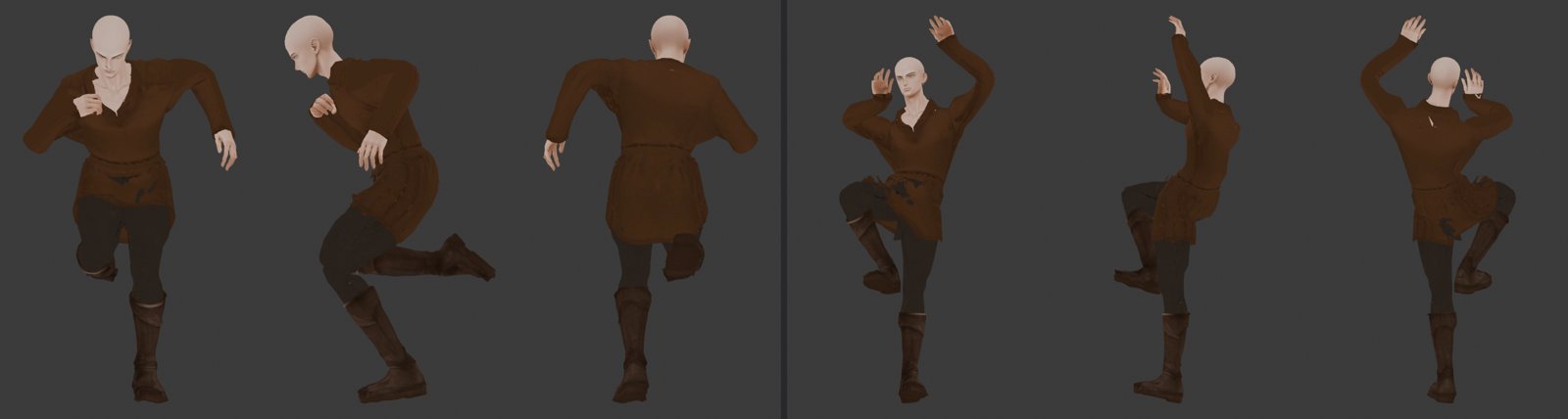
The base body in the outfit, running and climbing, front, side and back
In the game's posesa run and a climb · the body under each piece hidden
The Hooded Swordsman sheet on the left and the model in the game on the right, front, side and back
Who players see today, in the judgeleft: Mike's sheet · right: the live Hooded Swordsman, 2026-11-12
route 2

A whole figure from sheets: the bulky man

Peter's director · in the game, 0.30.55

Steps 1 to 11 make one body that clothes go onto. The bulky man (Look > Male > Figure: Bulky) went a shorter way: a whole figure generated straight from Mike's sheets and put on our skeleton by one recipe, with no modelling by hand. It suits a figure that should be in the game soon and won't change clothes: he is drawn bare, without the poncho, and the build sliders don't shape him.

  • The pictures. Every drawing has his arms down, and an arm drawn against the side comes back fused to it. So an image model (Qwen-Image, run on our own Mac) redrew Mike's front in an A-pose, arms 45 degrees out, then turned it to a three-quarter view and the back. Each was picked from a contact sheet of seeds for still being Mike's man, and shown to Peter.
  • One model from three views. A generator (Pixal3D) reads the front, the three-quarter and the back together. The three-quarter view is what keeps his build; adding the side view grew flaps at his toes.
  • His face is a second generation, from Mike's head sheet alone, joined on by one seam round the neck.
  • Onto our skeleton. Simplified to 28,000 triangles, repainted onto a new layout, and given the 65 bones with his own joints. Generated bodies are a skin with a second skin just inside it, so the weights are worked out on a solid copy, and the two skins are made to move together.
  • Every fix is a step of the recipe, so it all rebuilds from the committed pictures, the same bytes each time.

What lost, so the next figure can skip it: more seeds and arms bent out on the arms-down drawings (the arm stayed joined to the side from 0.7 of his height up), an automatic rig (SkinTokens) and the base body's weights carried over (both tore more at the armpits), and pictures without the head (the neck closed as a shelf). Still open: his lifted soles are flat, and his eyes are the generator's paint. The recipe: assets/source_models/bulky_man/README.md; every step and lesson: docs/ART_PIPELINE.md, "A second route".

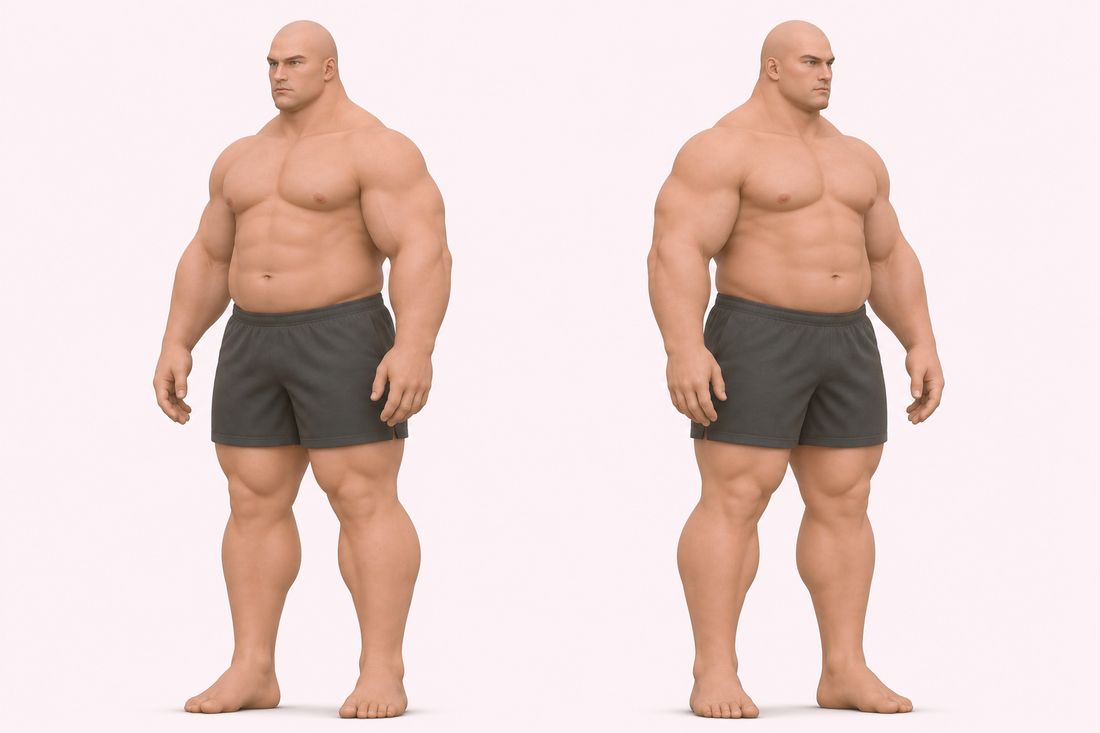
Mike's sheet of the bulky man: a very muscular bald man in grey shorts from two three-quarter views, arms at his sides
Mike's bulky manMike's drawing · arms down against his sides, as every drawing of him
Mike's turnaround front beside three generated pictures of the same man with his arms held out: front, three-quarter and back
Redrawn in an A-poseleft: Mike's turnaround · then the front, three-quarter and back Qwen-Image drew from it, picked from contact sheets
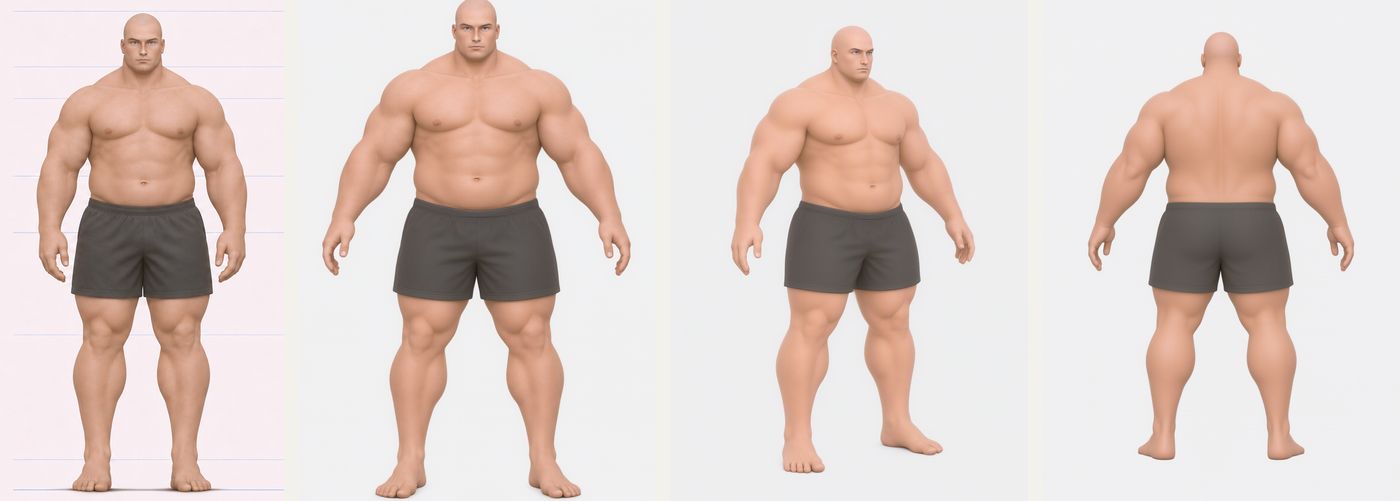
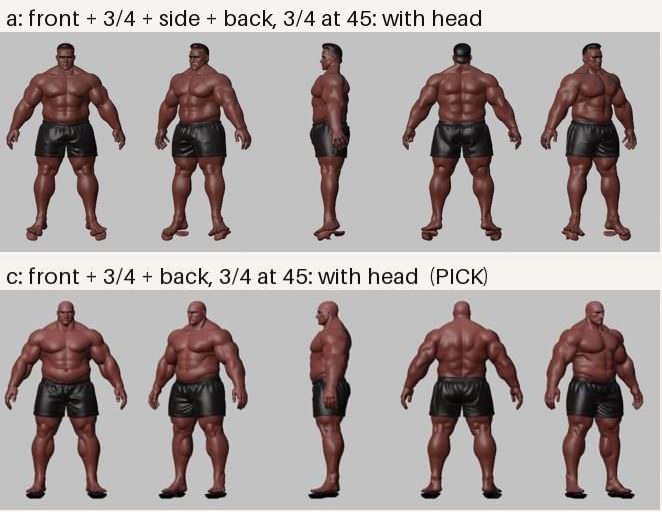
Two raw generations in five views: one from four pictures including the side, with flaps at the toes; one from front, three-quarter and back, the pick
The generator's raw modeltop: with the side view, flaps at the toes · bottom: front + three-quarter + back, the one picked (raw paint, before the recipe)
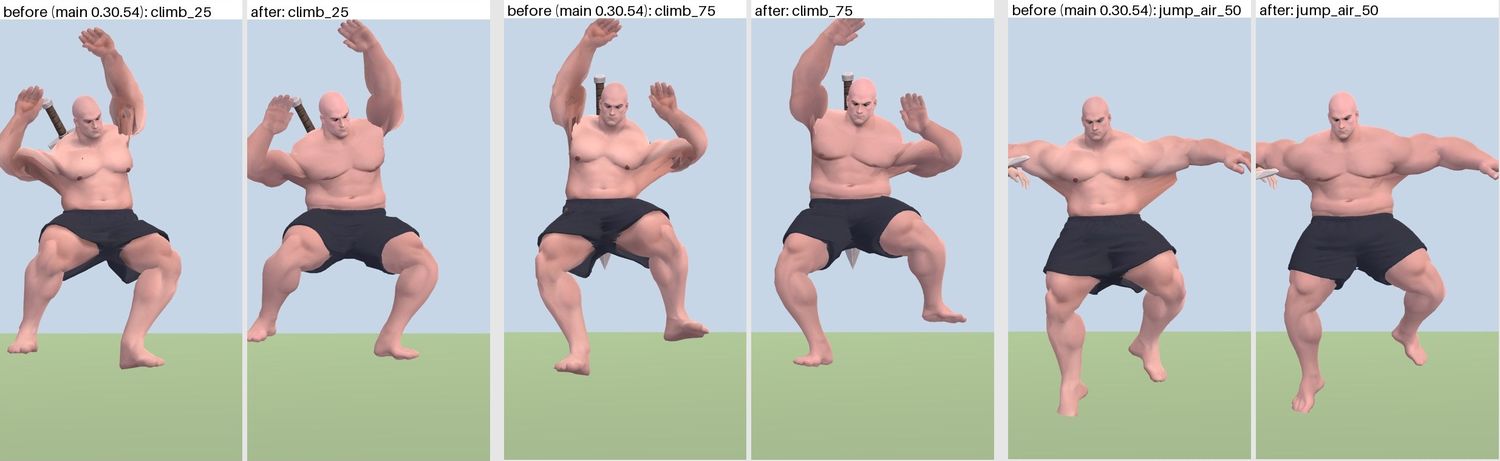
The bulky man in the game climbing and jumping, before and after: before, torn sheets of skin under the raised arms; after, clean armpits
In the game: from arms-down drawings, then from the A-poseeach pair: before (0.30.54) and after (0.30.55) · climb, climb, the top of a jump · the torn web under the arms is gone
status

Where each step stands

2026-11-12

Players today see the Hooded Swordsman: one fused body, with a head carried onto it and a simulated poncho. A man can also pick the bulky man, made by the second route. The dressable man replaces the Hooded Swordsman when steps 4 to 10 are done and he looks at least as good in the game. Two questions are open with Mike: whether the original swordsman drawing is the skinny build (Peter thinks so), and which drawing is the bar for the dressed man at medium.

StepStatusNotes
1 · The sheetspartly inThe bare man at three builds and the dressed man are drawn. Waiting on Mike (#1547): the outfit with the poncho off, and the woman's sheet (#1544).
2 · Consistency checknot builtNothing checks a sheet before modelling yet. The measures exist inside the face work.
3 · 3D basebuiltMike's Tripo model of the baseline, made on his paid plan. The woman's waits for her sheet.
4 · Head and facein progressMike's director, #1535, on a branch. The mouth has passed; eyes and eyebrows are close; nose and ears are being rebuilt.
5 · Simplifynot builtPeter's director, #1542. To about 20,000 triangles, after the face work.
6 · Onto our skeletonfirst passBuilt and held in every clip (#1557). The arm joints still have to move (#1542).
7 · Region mapbuilt, to redoMade on the body as generated (#1553), carried onto the simplified body; in the game as a UV picture the fit tool writes (#1538).
8 · Clothes as piecesfirst piecesThe fit tool is built (#1539); the swordsman's tunic, trousers and boots from generated pictures (#1538), on the base body and the bulky man.
9 · Build slidernot builtMike's three sheets are in. Today's man keeps Weight and Muscle until it is.
10 · Poncho, hair, hoodnot started#1541, the last step. All of it exists on today's man and has to be refitted.
11 · Into the gamebehind a switchThe game side is in with the swordsman's outfit (#1556, #1538). Becoming the default waits on steps 4 to 10 and on Peter's and Mike's sign-off.
Route 2 · A whole figure from sheetsin the gameThe bulky man, a man's Figure: Bulky (#1588; 0.30.48, then from A-pose pictures in 0.30.55). Still open: flat lifted soles, the generator's eyes (2026-11-14).
[+] what's in the pipeline, and its license
PartLicenseRole
The sheetsMike's own drawingsWhat every model is made from and judged against
Tripo, on a paid planIts terms give paid users all rights to what they makeSheet → the base model
Pixal3D, in AssetFurnace (run on our own Mac)MIT; AssetFurnace Apache-2.0Second route: pictures → the bulky man's model and head
Qwen-Image 2.1 (run on our own Mac)Qwen Research License; Qwen states the pictures it makes are not the licensed Materials. Peter approved committing them (#1588)Second route: Mike's drawings redrawn in an A-pose
Recipes, checks, the judge, shadersOur own codeEverything after the base model
Motion libraryCC0 (Quaternius)Walk, run, sit, jump and more